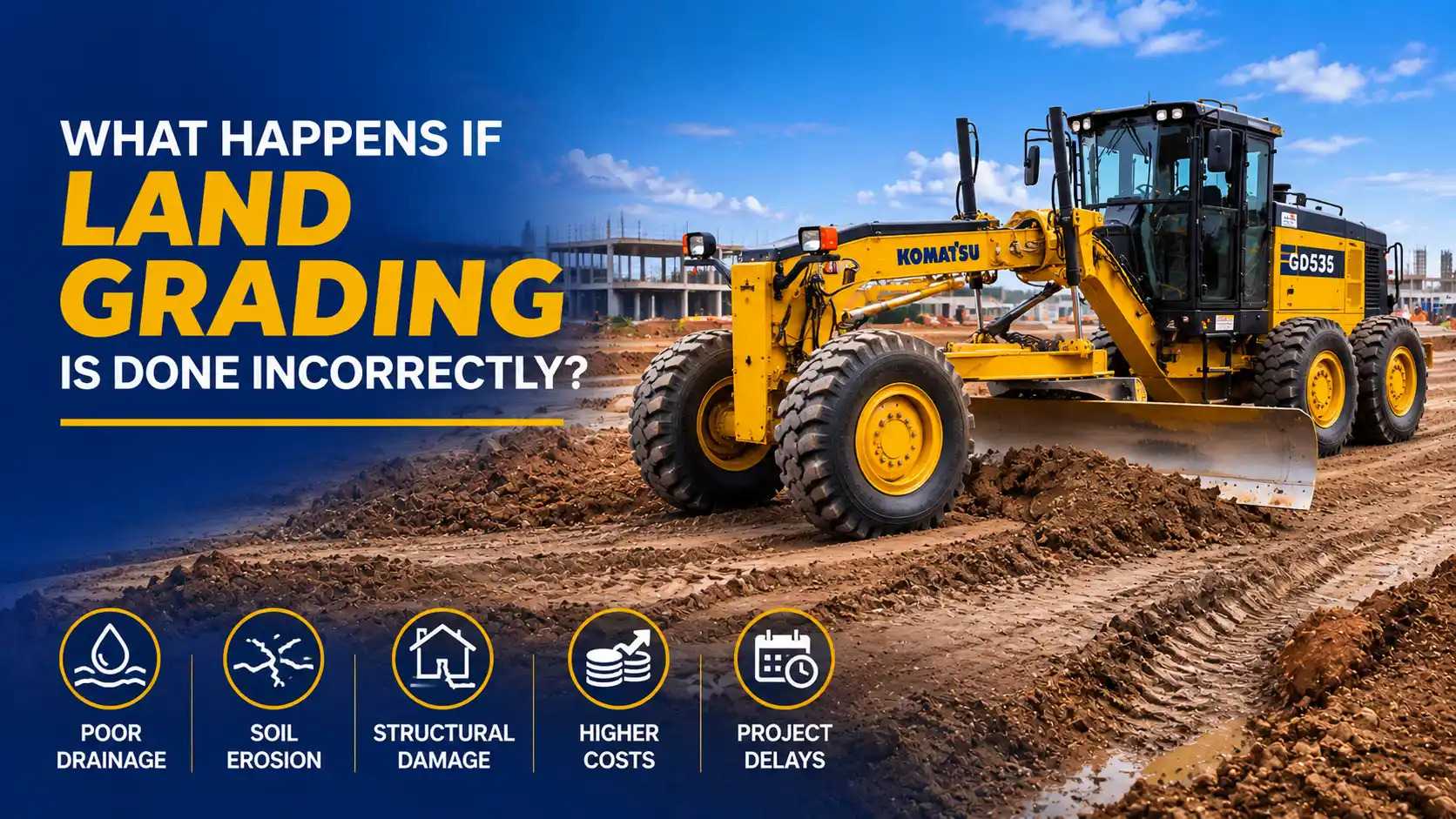
Land grading is the process of changing a site's elevation to prepare it for construction. One of the problems is that land that is poorly graded can cause excessive soil erosion, poor drainage, cost overruns, structural issues, road damage, and pavement failures. When a site is not sloped or levelled to project specifications, rainwater can collect in unintended areas or flow toward the road or building, causing the issues listed above. Equipment, such as a Komatsu **GD535-6** motor grader, can help excavators grade the ground properly.
Top 5 Factors that determine if land grading is performed correctly or incorrectly
1. Poor Drainage and Waterlogging
One of the most common issues that follow incorrect land grading is a poor drainage system. Any construction site needs proper slopes to route rainwater to the drainage system. Uneven ground grading can cause poor drainage, allowing water to pool instead of draining away and leading to mud, waterlogged areas, and less-than-ideal working conditions. Waterlogging can cause road failure, soil loss, and operational disruption. Grading and establishing the correct slope allows water to run off the site at the right angle.2. Soil Erosion and Ground Instability
There are times, when wrong grading mostly leads to the potential for erosion, especially on building sites that are sloped. Water can effectively wash away loose soil if the surface roughness and grading are not appropriate. This can lead to exposed bases, embankment and slope failures, and uneven ground surfaces. Before grading, contractors must analyse soil properties, natural topography, and water flow. Techniques such as good compaction, drainage control, and erosion control measures can save the finished grade.3. Foundation and Structural Problems
Land grading is a land improvement practice that can provide a solid foundation for structures of any type. When land is not correctly graded, foundations can be uneven, resulting in poor drainage, variable soil, and uneven soil levels. Before starting foundation work, the contractor should determine the required levels, ground levels, and soil type. Prepare the ground before foundation work.4. Uneven Roads and Construction Surfaces
The wrong grading can cause uneven surfaces, impairing the quality and usability of roads, parking areas, industrial sites, and work sites. Some of the common problems are as follows:- Uneven road elevations
- Incorrect cross slopes
- Surface depressions and bumps
- Poor water drainage
- Increased vehicle movement difficulties
5. Increased Construction Costs and Delays
This difficulty can cause students to make grading errors that are time-consuming and avoidable if the equipment is operated correctly. Contractors may have to excavate again, spread soil, drainage and redo compacted areas. These add labour, fuel, equipment rental, and material costs. Poor grading may also delay the construction of foundations, roads, and other planned projects. Reliable surveying techniques and skilled equipment operators minimise rework and improve project cost control.How the Komatsu GD535-6 Motor Grader Helps Prevent Grading Errors
The Komatsu GD535-6 is a motor grader from Komatsu India Private Limited used for road construction, levelling, and land grading. The grading blade is designed to cut, spread, and shape material to the specified surface profile. Gradients and smoothness of the surface can be achieved by correct blade positioning and careful operation. In order to achieve better grading results, contractors should:- Try to conduct a thorough site survey before starting work
- Do determine the desired heights and slope requirements
- Check soil conditions and drainage requirements
- Even try to use trained** motor grader** operators
- Examine completed surface(s) for flatness and alignment
- Coordinate grading with compaction activities