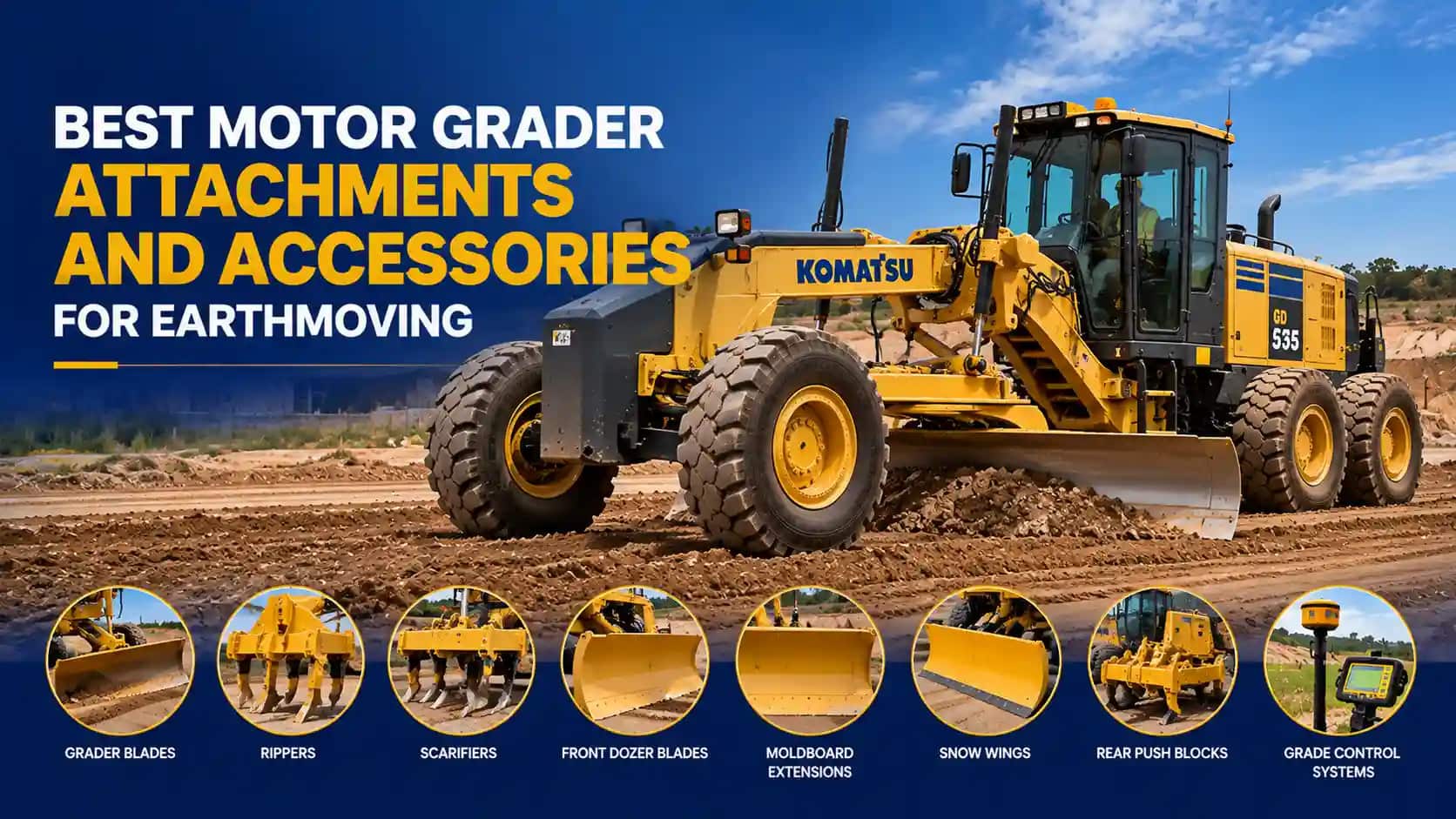
At times, a motor grader is only as dynamic as the tools which are attached to it. The best motor grader attachments and accessories completely depend on the work, whether you are building rural roads, maintaining mining haul roads, or levelling industrial land.
Furthermore, specialised attachments expand what a grader can do, and blade wear parts have the biggest recurring impact on finish quality, operating costs, and uptime. Choosing compatible equipment and maintaining cutting edges, end bits, and ripper tips helps keep earthmoving operations productive.
Motor Grader Attachments and Accessories at a Glance
| Item |
What it does |
Best for |
Wear or care note |
| Moldboard and blade extension |
Cuts, spreads, and levels material |
Road grading and shoulders |
Inspect edges and mounting bolts |
| Front dozer blade |
Pushes loose material |
Gravel piles and shoulder clearing |
Check blade wear and mounting |
| Rear ripper |
Breaks compacted ground |
Hard soil and haul roads |
Replace worn ripper tips |
| Scarifier |
Loosens the surface |
Soil conditioning and crust breaking |
Inspect teeth and holders |
| Cutting edges and end bits |
Cut material and protect blade ends |
Accurate grading and levelling |
Rotate or replace as required |
| Ripper tips and shanks |
Penetrate and break ground |
Compacted soil and weathered material |
Check tips, shanks, and fasteners |
| Snow plough |
Clears snow |
Snow-prone hill regions |
Inspect wear edges and mounting |
| Cab and technology accessories |
Improve visibility, comfort, and monitoring |
Extended shifts and demanding sites |
Check electrical and safety systems |
Why Attachments Decide What Your Motor Grader Can Do
1. One Machine, Many Jobs
With the right attachment, a grader can blade, loosen, and break up ground that has been panned together; scarify or pulverise the land; and finish and shape slopes and the road profile. That means no machinery on small to medium sites.
2. Fit Matters More Than Function
Most attachments are model-specific. Sometimes mounting positions, lift-group shape, machine weight, hydraulic flow, and operating forces must all match. A ripper or a blade intended for another grade might not fit safely or perform properly. Always check with the machine maker or authorised servicing agent.
Core Motor Grader Attachments
Moldboard (Main Blade) and Blade Extension
The moldboard is the major grading tool which is used to cut, move, spread, and shape soil or unique aggregates. A compatible blade extension certainly increases working width and can aid with embankment and road-shoulder work. The extension will suit the grader's blade and even its operating limits.
Front Dozer Blade (Push Block)
A front-mounted blade can push loose gravel, soil, and small amounts of displaced material. It is widely used to clear shoulders and move material over short distances, but it never replaces a bulldozer for heavy pushing or sustained applications.
Rear Ripper
The rear ripper breaks all kinds of compacted soil and hardened surfaces just before grading. Its rear position helps transmit ripping forces through the machine's drive tyres. Graders aren't designed for continuous heavy ripping of hard rock; difficult materials will require specialised equipment.
Scarifier (Front or Mid-Mount)
A scarifier can loosen the surface crust, fracture compacted layers, and break them up to be redistributed. Front-mounted units suit some initial loosening jobs, but mid-mounted models let you work near the grading area. Check what configuration your model offers.
Slope and Ditch Finishing Equipment
The moldboard is used to shape road crowns, embankment slopes, and drainage slopes. Depending on the make and model of equipment, foot or wing attachments may be available from the equipment supplier. Still, the availability and compatibility of the attachments should be checked before purchase.
Snow Plough and Wing (Hill Regions)
Snow-clearing machinery is mostly relevant to the snow country areas of Jammu & Kashmir, Ladakh, Himachal, and Uttarakhand. Contracts elsewhere are more likely to benefit from general grading and ground-conditioning machines.
Wear Parts: The Attachments That Cost You the Most
Tips, rippers, edges, and end bits are major operating costs if you don't replace them. How your grader wears will greatly affect your efficiency.
1. Cutting Edges
Normal steel edges are adequate for most soil and general grading; in very abrasive conditions, you will need more wear-resistant or carbide-insert edges. Wear rates differ for sand, murram, aggregate, and rock. Dull, uneven edges produce a rougher finish and require more passes.
2. End Bits
End bits protect the moldboard ends, which often wear out. Change worn-out or broken end bits before they damage the blade structure.
3. Ripper Tips and Shanks
The tips absorb most ground strikes and protect the shank. Look after the tips. If they are worn or rounded, replace them before they become blunt and put the shank at risk.
4. Bolts and Fasteners
Appropriate fastener specification and tightening torque. Bolts which have been lost, damaged or overstretched can result in one or more of the cutting edges moving, uneven wear and pose a safety risk.
5. When to Rotate or Replace
Follow the manufacturer's wear indicators, and watch for uneven wear, damage, reduced penetration, and reduced finish quality. For more information, see Komatsu's ground engaging tools guide.
Cab, Safety and Technology Accessories
Operator comfort and visibility are important, too, even on long grading shifts. Depending on your overall machine package, useful features include air conditioning, work lights, mirrors, and a rear-view camera.
Safety equipment certainly consists of appropriate rollover protection, a seat belt, a backup alarm wherever it is required and a fire extinguisher as per the site rules.
Komatsu definitely lists a ROPS/FOPS canopy, operator visibility features, and an adjustable seat for the
GD535-6. Please check the model specifications for all exact configurations. Do confirm whether monitoring or grade control options are available for your machine before budgeting them out.
Which Attachments for Which Indian Job?
| Job |
Key attachments |
Why |
| Rural and district road construction |
Moldboard, cutting edges, scarifier |
Shapes and finishes road surfaces |
| Highway and expressway subgrade and shoulders |
There is a presence of Moldboard, compatible blade extension |
Supports consistent profiles and wider passes |
| Mining and quarry haul road maintenance |
Moldboard, ripper, cutting edges and end bits |
Breaks surface crust and restores road shape |
| Land levelling for plots and industrial parks |
Moldboard, scarifier |
Spreads material and improves surface uniformity |
| Canal, embankment and airport work |
Moldboard and suitable slope-finishing equipment |
Helps form gradients and drainage profiles |
| Hill roads and snow clearing |
Moldboard, suitable snow plough where needed |
Supports grading and seasonal snow removal |
At times, the best setup depends on land levelling, site size, material movement, and the required finish. For projects that require equipment and an operator, browse the motor grader hiring guide.
How to Choose the Right Attachments
Before purchasing, refer to this checklist:
1. Double-check machine specifications:
Make sure that the machine model and attachment setup are the same as the original.
2. Check mounting and hydraulics:
Confirm the attachment's installation and hydraulic specifications are compatible.
3. Match machine capacity:
At times, consider operator weight, horsepower and forces created in work.
4. Choose appropriate wear materials:
Design the edge and tip to suit soil, aggregate or rock.
5. Check spare-parts availability and service availability.
Ask about warranty and fitting: explain what it covers, how it can be fitted and any maintenance requirements.
OEM vs Aftermarket Parts in India
While first- and second-line parts are widely available in India, their quality, dimensions, material grades, and lifespan vary. The cheapest quote for the same generic aftermarket item may not be the best option.
Ask suppliers about material grade, hardness, thickness, dimensions, compatibility, warranty, and expected performance under your actual operating conditions. Komatsu genuine parts offer a manufacturer-backed option for consistency and fit. Therefore, compare alternatives based on specifications and total operating cost, not price alone.
Cost and Payback: Where Your Money Goes
Thoroughly evaluate all attachment types based on operating cost per hour or per kilometre of finished road, not just purchase price. Longer wear life, fewer replacements, consistent grading, and reduced downtime can improve overall value.
Worn edges may increase the number of passes required, affecting fuel use and productivity. For equipment budgeting, read the motor grader hiring cost guide thoroughly.
Maintenance and Care for Attachments
Check the cutting edges, end bits, tips, bolts, pins, cylinders, and hydraulic hoses before we begin the job. Grease all lubrication points according to the maintenance timetable, and repair leaks or tighten loose bolts. After each use, clean mud and monsoon debris from the equipment and inspect all moving parts for corrosion, damage, and partial blockage.
Using Attachments Safely
Don't exceed the limits that the grader operator has set for the cutting edge. Clear bystanders from the area before moving. Lower the attachment before leaving the machine—check the machine's height and width before transporting it from site to site. Watch for overhead wires and other hazards before lifting equipment into position. Follow the same safety rules you use when operating a truck.
A Real-World Example: Haul Road Maintenance
Illustrative example, not a documented customer case
Mine or quarry haul roads may develop corrugations, surface compaction, and ruts from heavy vehicle traffic. These conditions make travel uncomfortable and increase tyre wear and vehicle stress.
A suitable approach is to use a compatible rear ripper to loosen the compacted surface where necessary, followed by the moldboard to redistribute material and restore the road profile.
Fresh cutting edges and end bits help you maintain a consistent finish. The result is a smoother, better-shaped haul road when the work matches even ground conditions and is performed properly. Regular inspections and maintenance help you prevent minor surface problems from becoming more demanding repairs.
How Komatsu India Supports Motor Grader Work
Motor Graders
The Komatsu India
motor grader range includes the GD535-6, with 110 kW (148 HP) gross power, an operating weight of 15,140 kg, and a standard blade length of 3710mm. Please check the official page for current specifications and configuration details.
Attachments, Ground Engaging Tools and Genuine Parts
Explore our genuine ground engaging tools and parts to help you evaluate suitable solutions for your equipment and applications.
Service, Monitoring and Training
At this stage, Komatsu India offers support resources such as preventive maintenance and operator training. Do ask the authorised team which services and features are available for all of your machines.
Conclusions
Select the correct cutting edges, end bits and ripper tips for your application. When you need a ripper or scarifier, it can be mounted as shown. When backfilling or pushing material, consider fitting a front blade.
Ensure attachment compatibility before mounting. Call your local Komatsu India Private Limited representative for motor graders, attachments, ground-engaging tools and parts for all your earthmoving needs.
Frequently Asked Questions
1. What are some of the most popular attachments for motor graders in India?
At times, standard motor grader attachments include moldboards (blade extensions), a rear ripper, front dozer blades, a cutting edge, and the motor grader.
2. What are the possible components of a Komatsu GD535-6 motor grader?
Select attachment(s) in accordance with the application, environmental conditions, the equipment model, as well as proven GD535-6 compatibility.
3. When should motor grader cutting edges and ripper tips be replaced?
Change or rotate your tyres when they meet the wear indicator specifications, show uneven wear, have low penetration, or when grade quality is inferior.