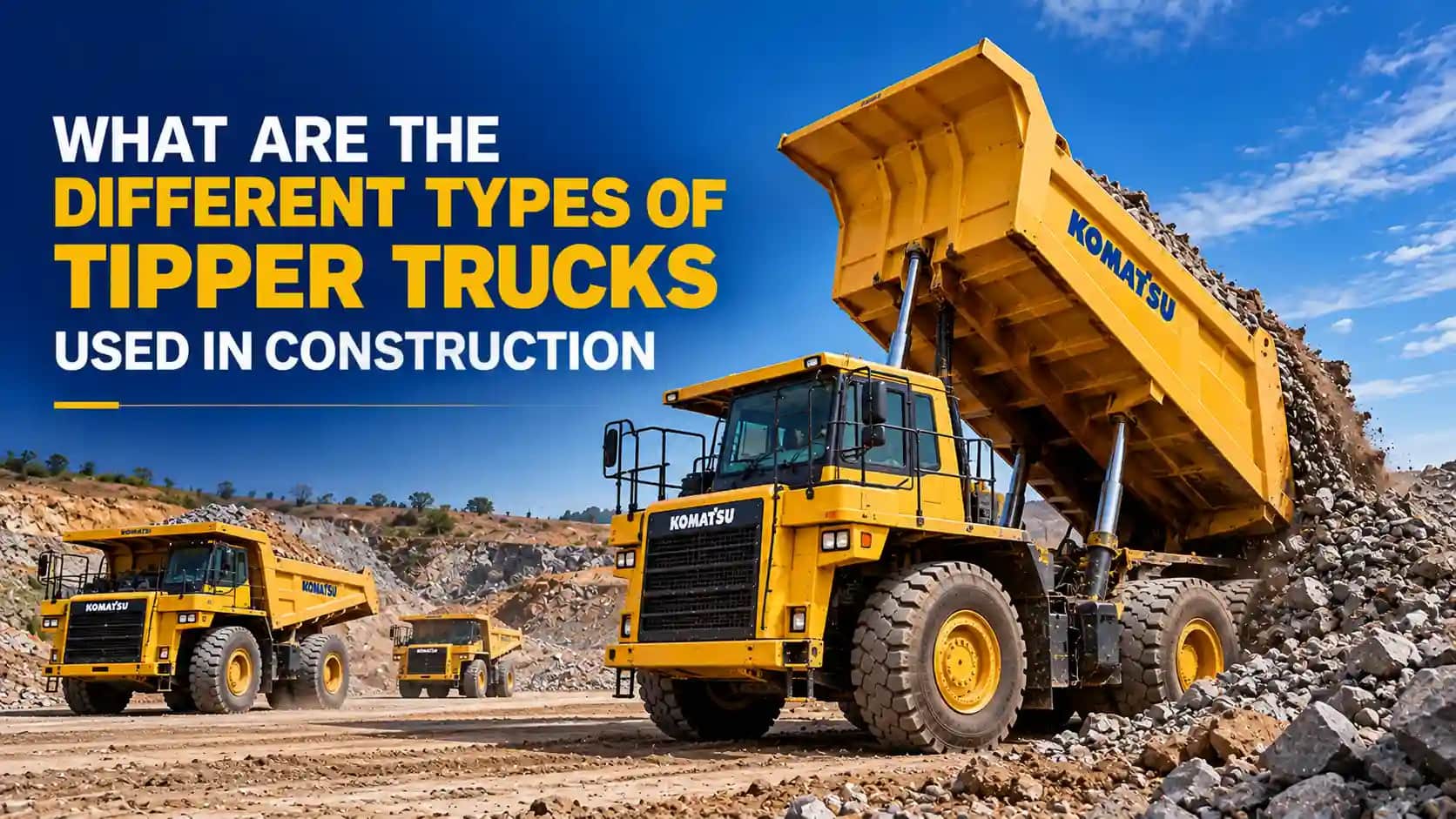
On Indian construction sites, tipper trucks are as important as the builders. Dump trucks move soil, sand, aggregate, rocks, and construction debris from one place to another, day after day. If you're choosing a tipper, keep these key factors in mind: the load you'll carry, the material you're carrying, and the range you're working within. Find the tipper or dumper type that best suits your needs.
Tipper Truck Types at a Glance
| Type |
Typical Use on Site |
Strength |
Limitation |
| Mini and small tippers |
Small sites, landscaping, narrow lanes |
Compact and maneuverable |
Limited payload |
| 6-wheeler tippers |
Urban construction and short hauls |
Suitable for lighter loads |
Lower carrying capacity |
| 10-wheeler (6×4) tippers |
Soil, sand, and aggregate transport |
Good balance of capacity and versatility |
Less suitable for very large hauling volumes |
| 12-wheeler (8×4) tippers |
Large construction sites and light mining |
Higher potential payload |
Requires more space to manoeuvre |
| Multi-axle tippers (14 wheels and above) |
Large infrastructure and long-haul operations |
Greater load distribution and carrying potential |
Higher operating costs |
| Off-highway rigid dumpers |
Large mines, quarries, and major earthmoving projects |
Very high payload capacity |
Generally unsuitable for ordinary public-road transport |
Real payloads and suitability will vary by vehicle specifications, body design, axle ratings, material density, and road legislation.
Tipper or Dumper? Clearing Up the Terms Used in India
In India, a tipper is more of a road-going truck with a tilting body that dumps material. The word dumper is equally common as a colloquial term for this type of vehicle, but can also be applied to much larger off-highway hauling machinery.
You might also hear these:
Tipper lorry
Another term for a road-going tipper, used regionally.
Hyva
An informal name given to hydraulic tipping trucks.
10-tyre or 12-tyre tipper
A wheel/tyre based description of the vehicle.
Scoop body
A body designed to discharge material.
Rock body
Reinforced chassis for corrosive, heavy, and shock-prone surfaces.
At Komatsu India Private Limited, our experts believe these definitions make it easier to compare vehicles, body capacities, and equipment specs.
Types of Tipper Trucks by Size and Axle Configuration
The number of wheels and axle configuration can affect a tipper's load-carrying capacity, steering, and off-road grip.
Mini and Small Tippers
The compact, pickup truck-style tippers are used on small roads for landscaping, minor repairs, and construction in residential neighbourhoods. They suit tight work sites that larger trucks can't access, which may require extra trips.
6-Wheeler Tippers
Six-wheel tippers definitely suit relatively lightweight construction activities, urban areas, and high-frequency use over short distances. They offer a useful balance of payload and manoeuvrability for contractors who do not operate heavy-duty trucks.
10-Wheeler (6×4) Tippers
10-wheeler dumper trucks are popular in Indian construction equipment & material transportation. 6×4 is the most common term and refers to the configuration in which 6 wheels are driven. They transport bulk soil, sand, and aggregates between loading areas, construction sites, and approved disposal areas.
12-Wheeler (8×4) Tippers
An 8×4 setup usually has 8 wheels. An 8×4 can transport more material than smaller configurations and can handle larger earthmoving projects and certain light-mining operations. Nevertheless, consider size, turning capacity, and weight limitations.
Multi-Axle Tippers (Fourteen Wheels & Up)
Multi-axle machines excel at high-intensity hauling tasks where their rated capacity and operating economics make them viable. 10×2 and 10×4 variants may have different axle drives and layouts. Extra axles spread the load, but you don't get a free passenger when you add them.
How to read axle codes?
In something like a 6×4, the first number usually indicates wheel positions, and the second indicates driven wheel positions. Always check the manufacturer's specifications, as wheel-counting conventions and vehicle configurations can vary.
Types of Tipper Bodies and What They Carry
The body should match the material that is being transported. The wrong design can increase wear, reduce usable volume, and make unloading tasks difficult.
Box Body Tippers
Box bodies are a dynamic option even for general construction materials, including soil, sand, and aggregates. Their relatively straight sides provide good carrying capacity.
Scoop Body Tippers
Scoop-shaped bodies can help certain materials slide out during unloading. Their suitability depends on the material's moisture, consistency, and stickiness.
Rock Body Tippers
All rock bodies feature reinforced construction to withstand the increased impact of blasted rock, boulders, and special quarry material. They're robust enough for even the toughest excavation and quarry applications.
Body Volume and Rated Payload
Body capacity is mostly measured in cubic metres, not the same as legal payload, which is measured in tonnes. Sometimes, dense aggregate can reach the truck's permitted weight before the body is full. You are required to calculate both material weight and volume, and follow the applicable overloading rules.
Types of Tipping Mechanisms
Rear Tipping
Rear tipping is the norm on many construction tippers. The hydraulic body lifts the body, and the material is ejected out the back of the vehicle.
Side and Three-Way Tipping
Where rear unloading is limited, side tipping may be an option. Three-way systems can unload to the sides as well as at the rear, but the type and body need to be considered; check manufacturer details when choosing a vehicle for an Indian construction site.
Hydraulic System Fundamentals
Hydraulic cylinders, hoses, body supports and control mechanisms must be examined periodically. Operators should work from level ground in accordance with the manufacturer's operating instructions and should never work under a raised body unless the safety supports are in place.
Tipper Trucks vs Off-Highway Dumpers: Where the Line Falls
On occasion, road-going tippers suit all types of public road transport and standard construction projects. For high-volume loads in major quarries and mines, however, purpose-built off-highway rigid
Dump truck will be more productive, since routes are often more tightly managed.
It is influenced by haul volume, road access and distance, permissible payload, tyre cost and condition of the haul road. Articulated dump trucks such as 830-5 from Komatsu India Private Limited are also found to perform well on some soft or rough ground conditions depending on availability of equipment and requirements of the project.
For instance, Komatsu India's
830E-5 mining dump truck comes with an overall capacity of 227 tonnes. It's designed for large-scale mining and heavy hauling, not typical urban tipper duties.
Match the Tipper to the Loader
Of course, a tipper's productivity depends not only on its payload, but also on how efficiently the loading machine fills it. A truck waiting for an excavator is unproductive for part of the time, while an excavator waiting for trucks can never be productive.
Bucket Passes and Fill Time
A simple estimate is
Bucket passes=Tipper body volume/Effective bucket load
The effective bucket load depends on bucket capacity and the fill factor. Actual loading depends on material density, bucket geometry, operating technique, and the safe payload limit.
Worked Example
16/0.35 = approximately 46 bucket passes, seven before accounting for fill factor.
This quick, subtle estimate shows why a small excavator might take considerable time to fill a large tipper. It isn't a recommended fleet pairing; the actual match should account for material density, legal payload, excavator performance, and loading cycle time.
Choosing the Right Excavator Class
Always choose the excavator based on the tipper's body volume, material type, target loading time, and site constraints. For more information, explore Komatsu India's
hydraulic excavators range to compare equipment for unique loading requirements.
Payload, Overloading and Road Limits
A tipper's legal payload is determined by the gross vehicle weight (GVW) registered on the registration certificate, the number of axles, vehicle specification, and regulations. The primary statutory fine (India), under Section 194 of the Motor Vehicles Act, is ₹20,000, plus an additional ₹2,000 for each tonne over the limit, plus unloading charges for the excess material. Find the requirement.
A larger vehicle body does not mean the truck's legal payload. Check axle limits and vehicle documentation, weigh loads as necessary, and load properly.
Diesel, CNG and Electric Tippers
Diesel Tippers are commonly used for construction hauling work; CNG, LNG, and electric options may suit particular urban, short-distance, fixed-route operations. This mostly depends on local availability.
Before choosing an alternative powertrain, assess range, refuelling or charging access, payload, duty cycle, and total operating cost rather than relying on fuel type alone.
Choosing Based on Indian Site Conditions
Narrow urban lanes and restricted hours
Always consider compact vehicles and shorter wheelbases where permitted.
Monsoon and soft ground
Certainly, evaluate traction, axle configuration, drainage, and haul-road conditions.
Hilly/ghat routes
Give braking performance, gearing, load limits and route suitability.
Quarries and rock sites
It is simple: choose reinforced bodies and consider tyre, floor, and sidewall wear.
Cost Factors Beyond the Purchase Price
Do compare cost per tonne hauled rather than purchase price alone. Fuel consumption, tyres, body wear, maintenance, downtime, financing, resale value, and the number of trips all affect lifetime cost. For future planning, consult guidance on equipment purchase and rental versus hiring before committing to a specific fleet.
A Real-World Sizing Example
Consider an illustrative road construction project that requires moving excavated soil from a work zone to an approved disposal site several miles away. At times, a contractor will compare 10-wheeler and 12-wheeler tippers based mostly on road access, legal payload, material density, and daily hauling targets.
The contractor should match the selected truck to an excavator which can fill it effectively without exceeding its permitted weight. If the route passes through narrow streets, a smaller vehicle may be more practical, despite requiring additional trips.
How Komatsu India Supports Material Moving
Excavators That Load Tippers Efficiently
Komatsu India offers excavators across a range of size classes. Matching the excavator's bucket, loading cycle, and working conditions to the hauling fleet can help you improve material-handling productivity.
Off-Highway Dump Trucks for Large Sites
For large-scale mining and hauling applications, consider Komatsu mining dump trucks, including the 830-5. Most are specialised off-highway machines, completely distinct from road-going construction tippers.
Service, Parts and Monitoring
Equipment uptime often depends on scheduled service, spare parts, and on-time delivery. Contact Komatsu India Private Limited for support, genuine spare parts, and monitoring solutions for your equipment and new applications.
Which Tipper for Which Construction Job?
| Job |
Recommended Tipper Type |
Body Type |
Why |
| Urban infill and narrow lanes |
Mini or small tipper |
Compact box body |
Easier access |
| Road base and aggregate supply |
10-wheeler or suitable multi-axle tipper |
Box body |
Versatile material transport |
| Earthwork and excavation spoil |
6-wheeler or 10-wheeler |
Box body |
Practical for routine earthmoving |
| Sand and fine material supply |
Suitable 6-wheeler or 10-wheeler |
Box body |
Adaptable to loose materials |
| Blasted rock and quarry feed |
Heavy tipper or off-highway dumper |
Rock body or specified mining body |
Handles impact and abrasive loads |
| Demolition and construction debris |
Suitable heavy tipper |
Reinforced body as required |
Better resistance to irregular loads |
| Expressways, dams, and large quarries |
Multi-axle tipper or off-highway dumper |
Project-specific body |
Supports high-volume hauling |
Urban construction focuses on turning space, access controls and manageable loads. For road construction, compare the truck's payload with the daily tonne requirement and haul distance. For quarries and large infrastructure projects, it depends on which option makes sense based on operating cost per tonne per km: a road-going tipper or a dedicated mining dumper.
Conclusion
Selecting the right tipper truck for your construction site in India depends on size, number of axles, body shape, tipping design, payload, and site factors. Also consider how quickly your excavator can load the trucks. Talk to Komatsu India to find out if your loading and hauling needs are met.
Frequently Asked Questions
1. What are the types of tipper trucks used in construction works in India?
Popular types include mini tippers, 6-wheelers, 10-wheelers, 12-wheelers, multi-axle tippers, and Off-highway dump trucks.
2. What is the difference between a dumper and a tipper?
A tipper truck is mostly used for loading and unloading on roads, whereas a dumper generally refers to a heavy-duty dump truck for construction sites, quarries, and mines.
3. What is the best tipper truck for construction jobs?
Select a tipper based on material volume/weight, payload capacity, distance to the tip site, construction conditions, loading vehicles, and legal weight/volume limits.
4. What is the difference between box-body tipper and rock-body tipper?
A box-body tipper is recommended for sand, soil and other common materials. A rock-body tipper provides additional reinforcement to accommodate the weight and abrasive properties of rocks and aggregates.
5. Can I use the Komatsu 830E-5 for public-road construction?
The Komatsu 830E-5 is a high-capacity, ultra-class mining dump truck intended for use in large-scale mining operation.