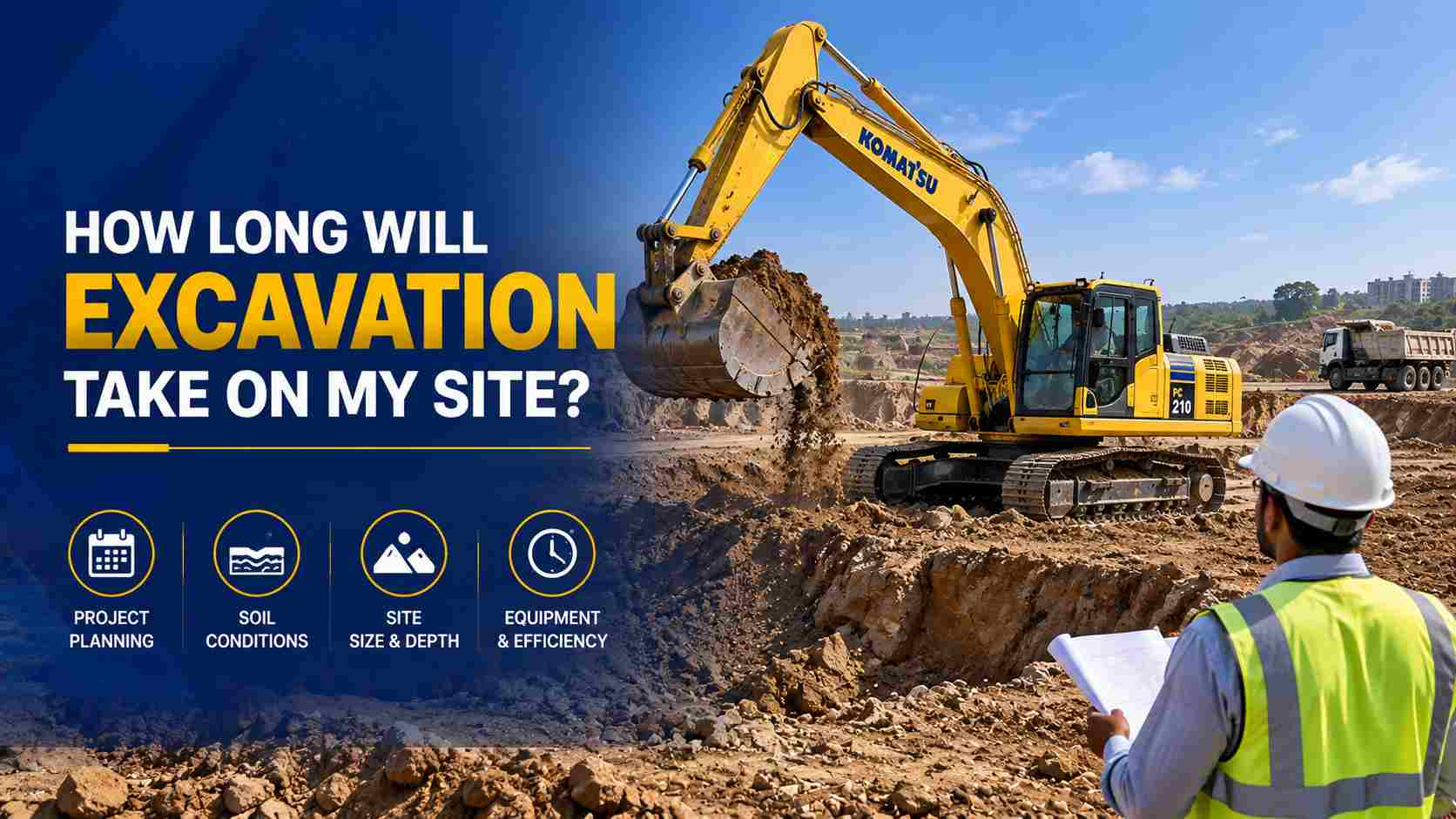
Excavation is a critical, and often first, phase of many construction, infrastructure, landscape, and earthmoving initiatives. However, one question almost every project manager, contractor, and site owner wants answered is: How long will excavation take on my site?
The time required for excavations is influenced by various factors such as the size of the excavation area, soil conditions, depth of excavation, volume of material to be removed, conditions of the site, operator experience, and the type of excavator used, and ranges from one site to another; there is no single answer.
The right excavator does impact productivity. Machines like the
PC205-10M0 are designed to offer contractors high performance, durability, fuel efficiency, and reduced maintenance for effective, efficient excavation.
How long does it take to excavate?
To estimate excavation time, you need to know the factors that affect machine productivity.
1. Size and Depth of the excavation
The total amount of material to be excavated is one of the biggest factors. Earthmoving for a small foundation trench can take a few hours, while a larger-scale project can take days or weeks.
If excavation needs to be deeper, it can take longer, as the operator may need to move the machine, manage the excavated material, and work carefully around existing structures and utilities.
2. Soil and Ground Conditions:
All ground cannot be mined at the same rate. Compacted soil, clay, gravel, and rock are generally harder to remove than loose soil and sand.
Special attachments or extra excavation equipment might be needed to dig on hard ground, which can extend the excavation duration. Wet or unstable ground can also slow operations because the machine may need to be operated more carefully to stay stable and safe.
3. Excavator Performance
The speed with which material can be removed depends on the
excavator being used. The machine's productivity depends on the engine power, hydraulic performance, bucket capacity, swing speed, digging force, and work equipment.
The Komatsu PC205-10M0 is designed to provide high performance while offering lower initial costs. Durability and reliable performance of these excavators in challenging applications are achieved thanks to its improved work equipment and the new swing circle rigidity. Contractors can use these features to maintain consistent productivity throughout the day.
4. The PC205-10M0 can help to increase productivity
The PC205-10M0 has features designed to improve efficiency and cut costs. A key improvement is reduced hydraulic piping loss, which lowers fuel consumption. When these excavators operate for extended periods, better hydraulic efficiency helps the machine do its job while keeping fuel consumption under control. Fuel efficiency can reduce operational costs and support budget management for contractors.
5. Maintenance can impact project timelines
Excavation time isn't only about how smoothly the equipment digs; It also depends on machine downtime. A sudden part failure can delay excavation and other on-site operations. The PC205-10M0 includes new features that help you identify and anticipate failures in critical components. Its monitor panel provides wide positioning information that helps you maintain the machine, identify potential issues, and act in time. Less maintenance time means more time on the job.
6. Operator Experience Matters
These excavators still require a proficient operator to work them in such efficient cycles. A skilled operator’s actions translate into smooth digging cycles and minimise wasted or dead movements by positioning the machine correctly to load trucks effectively.
Operators are also more productive when they are comfortable during extended working periods. The PC205-10M0 offers a large, comfortable cab. Comfortable working conditions can help minimize fatigue and keep operators focused during excavation work.
7. Excavation safety and visibility
Never compromise safety to speed up the excavation program. Operators must have good visibility around the machine, particularly when working close to people, vehicles, buildings, and/or equipment.
The rear view monitor system will be a PC205-10M0 to enhance safety and comfort. It also features a large, high-resolution LCD monitor so that the operator can access important information at a glance. Improved visibility and monitoring help operators work confidently and stay aware.
8. KOMTRAX and Equipment Management
Operating the machine is not the end of the process in an excavation project. Contractors are also responsible for tracking equipment usage, maintenance, and overall performance.
The PC205-10M0 is equipped with a monitoring system for equipment management (KOMTRAX), Komatsu's machine-tracking system. KOMTRAX enables users to track machine information and manage their machines more effectively.
Knowing equipment details helps contractors make better choices, determine the level of care each piece of equipment needs, and estimate how much time it will remain idle. Ultimately, good management saves time and improves cash flow.
So, How Long Will Excavation Take?
Excavation time varies based on volume, soil conditions, excavation depth, site access, required precision, truck availability, and excavator productivity. For example, a relatively small soft-soil excavation with good site access could be done quickly. The more intense the excavation (e.g., hard ground, restricted access, deep digging, frequent machine repositioning), the longer it will take. The most reliable way to estimate the schedule is to estimate the volume of material to be removed and then account for the excavator's likely production rate given the site conditions.
Concluding Thought
A last, but still vital, question in the back of anyone’s mind - How long will excavation with a PC205 take? Of course, there is no one-size-fits-all answer to excavation with a PC205 – it entirely depends on the site specifics.
As a general rule of thumb, to give you an indication of what a PC205 can produce under the right conditions, typically a PC205-class machine will output somewhere in the range of 80-150 m3 per hour. Whether your production rate is higher or lower will depend on a whole raft of variables, such as the specific soil type you are excavating, your excavation depth, ease of site access, number of trucks for spoil cartage, complexity of your required excavation, etc., to name a few.
To estimate your project properly, first assess how many cubic metres you need to excavate, then apply a realistic production rate for the on-site conditions. A suitable contingency for unavoidable delays will give you a realistic time frame.
Once you have established your site parameters (dimensions, excavation depth, soil type) and the number of PC205s you will be running, you can also estimate the machine hours and working days required before moving your equipment onto site. This planning should help you to reduce downtime, save costs, and ensure the project is completed on time.
FAQs
1. How much digging can be done in an hour by using a PC205 excavator?
A PC205 can dig about 80-150 m per hour on the job site—excavation volume (per hour) of other excavators.
2. What affects the productivity of the PC205 excavator?
Site conditions, soil type, excavation depth, and the availability of support and trucks mainly affect the PC205 excavator's productivity.
3. If we use more PC205 excavators, can we shorten the digging time?
Yes. You can reduce digging time, but the work area must have enough space and trucks to support the increased production volume from more excavators.